The Centers for Medicare and Medicaid Services (CMS) has proposed a Podiatry MVP, which would be available for reporting in the 2026 performance year.
Although MVP reporting is currently voluntary, CMS has expressed the intention of sunsetting traditional MIPS and transitioning to MVPs entirely in the future. In the 2025 MIPS proposed rule, CMS requested feedback on the possibility of making MVPs mandatory as early as 2029.
Anatomy IT will continue to advocate for MVPs to be optional and for improvements to the Podiatry MVP to make it possible for all podiatric subspecialties to be successful.
In this blog, we’ll break down what MVPs are, how to report them, and what measures and activities are proposed for the Podiatry MVP.
What is a MIPS Value Pathway (MVP)?
CMS introduced MVPs as an alternative reporting option to traditional MIPS in 2023. According to CMS, MVPs aim to simplify MIPS, reduce reporting burden, and help patients make more informed decisions when choosing their clinicians.
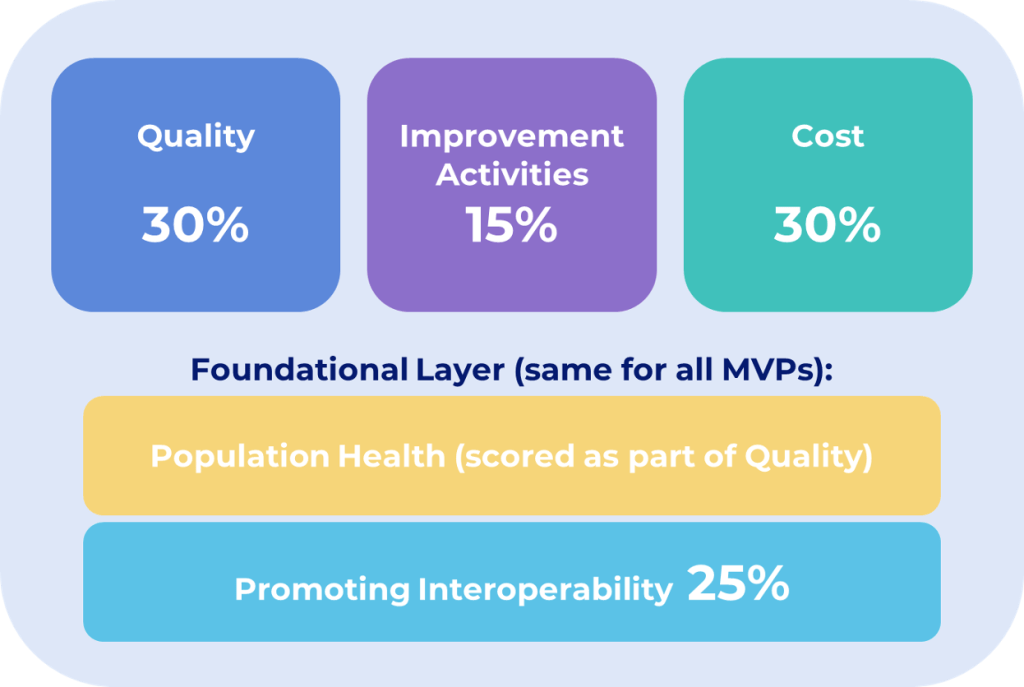
Each MVP has its own specific set of quality measures, improvement activities (IAs), and cost measures, and you are limited to those measures and activities when reporting the MVP. The Promoting Interoperability (PI) category is included as part of a “foundational layer,” meaning that PI requirements are the same for every MVP. Also included in the foundational layer is a population health measure, which contributes to your overall Quality score.
Can I Report an MVP Through a Registry?
Since 2023, Qualified Registries (QRs) and Qualified Clinical Data Registries (QCDRs), such as Registry Clearinghouse, have been required to support all measures in the Quality, IA, and PI categories of the MVPs relevant to their clinicians.* They are not required to support the Cost category, Population Health measures, QCDR measures, or the CAHPS for MIPS Survey.
While registries must support MVPs relevant to their clients, MEX5 and all REGCLR measures are only available through Registry Clearinghouse. Similarly, all USWR measures are only available through the U.S. Wound Registry.
*Because QRs and QCDRs report the 2026 measures and MVPs they will support to CMS by September 2025 and the Final Rule will not be published until October or November, CMS is proposing to allow QRs and QCDRs an additional year to support a new MVP after it’s finalized. This means that QRs and QCDRs would have until 2027 to start supporting MVPs finalized in 2026.
How Are MVPs Different from Traditional MIPS?
The table below highlights the differences by category between reporting traditional MIPS versus reporting an MVP.
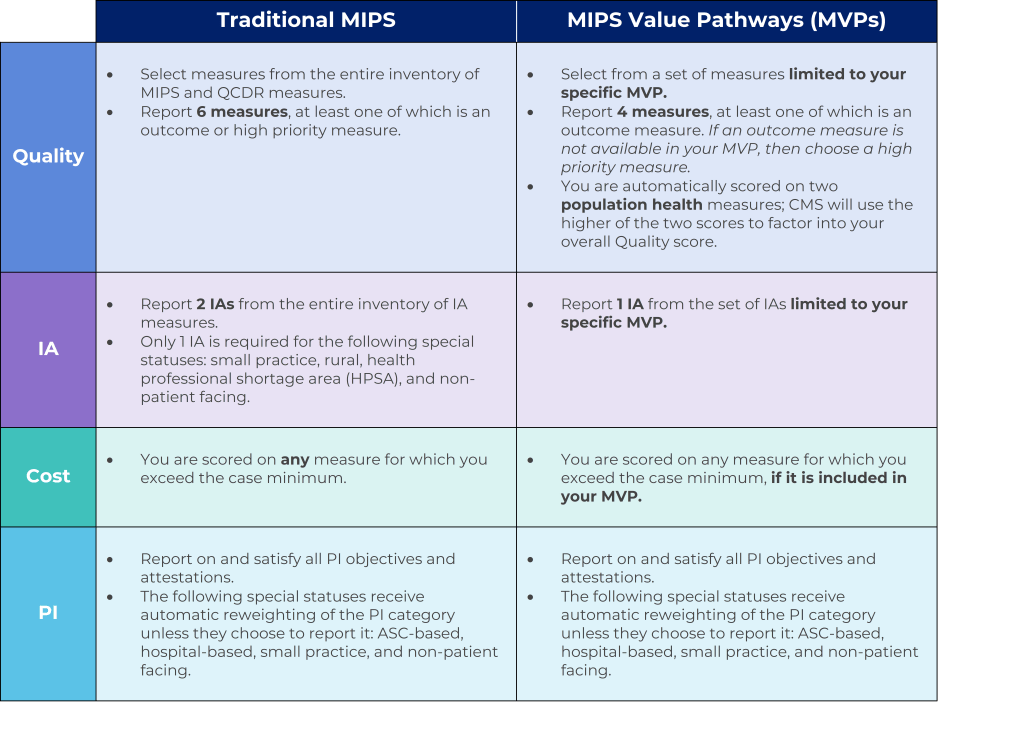
If you choose to report both traditional MIPS and an MVP, CMS will assign you the higher of the two scores.
How Do I Report an MVP?
To report an MVP, you must register during the registration window, which typically opens in April and closes in December. Registration is available through your QPP account.
At the time of registration, you must include the following information:
- The MVP you are choosing to report,
- Any administrative claims measures you would like to be included as 1 of your 4 required Quality measures,
- Whether you are planning to count the CAHPS for MIPS Survey measure towards 1 of the 4 required Quality measures, and
- Your participation level (group, subgroup, individual, APM).*
If you report at the group level and are part of a multispecialty group, you will be required** to report at the subgroup level starting in 2026. CMS is proposing to have groups self-attest to their specialty composition during the registration process beginning in 2026. CMS is also proposing to exempt small practices from the mandatory subgroup reporting requirement.*
If you are an Anatomy IT client, we will discuss whether to report an MVP during your kickoff call.
What Measures Are Proposed for the Podiatry MVP?
Click on the category names below to see the measures and activities proposed for this MVP.
Podiatry MVP Measures (Specific to This MVP)
Podiatry MVP Quality Measures
- 126: Diabetes Mellitus: Diabetic Foot and Ankle Care, Peripheral Neuropathy – Neurological Evaluation
- 127: Diabetes Mellitus: Diabetic Foot and Ankle Care, Ulcer Prevention – Evaluation of Footwear
- 155: Falls: Plan of Care (high priority)
- 226: Preventive Care and Screening: Tobacco Use: Screening and Cessation Intervention
- 317: Preventive Care and Screening: Screening for High Blood Pressure and Follow-Up Documented
- 358: Patient-Centered Surgical Risk Assessment and Communication (high priority)
- 374: Closing the Referral Loop: Receipt of Specialist Report (high priority)
- MEX5: Hammer Toe Outcome (outcome, high priority)
- REGCLR1: Heel Pain Treatment Outcomes for Adults (outcome, high priority)
- REGCLR3: Bunion Outcome – Adult and Adolescent (outcome, high priority)
- REGCLR5: Offloading with Remote Monitoring (outcome, high priority)
- REGCLR8: Monitor and Improve Treatment Outcomes in Chronic Wound Healing (outcome, high priority)
- USWR22: Nutritional Assessment and Intervention Plan in Patients with Wounds and Ulcers
- USWR32: Adequate Compression at each Visit for Patients with Venous Leg Ulcers (VLUs) Appropriate to Arterial Supply (outcome, high priority)
- USWR33: Diabetic Foot Ulcer (DFU) Healing or Closure (outcome, high priority)
- USWR34: Venous Leg Ulcer (VLU) Healing or Closure (outcome, high priority)
- USWR35: Adequate Off-Loading of Diabetic Foot Ulcers Performed at each Visit, Appropriate to Location of Ulcer
- BE_6: Regularly Assess Patient Experience of Care and Follow Up on Findings
- BMH_12: Promoting Clinician Well-Being
- CC_19: Tracking of Clinician’s Relationship to and Responsibility for a Patient by Reporting MACRA Patient Relationship Codes
- EPA_X: Enhance Engagement of Medicaid and Other Underserved Populations
- PM_14: Implementation of Methodologies for Improvements in Longitudinal Care Management for High Risk Patient
- PSPA_7: Use of QCDR data for ongoing practice assessment and improvements
- PSPA_18: Measurement and improvement at the practice and panel level
- PSPA_22: CDC Training on CDC’s Guideline for Prescribing Opioids for Chronic Pain
- PSPA_23: Completion of CDC Training on Antibiotic Stewardship
- MVP: Practice-Wide Quality Improvement in MIPS Value Pathways
- Medicare Spending Per Beneficiary (MSPB) – Clinician
35-episode case minimum
Foundational Layer (Applies to All MVPs)
- 479: Hospital-Wide, 30-Day, All-Cause Unplanned Readmission (HWR) Rate for the Merit-Based Incentive Payment Systems (MIPS) Groups
- 484: Clinician and Clinician Group Risk-standardized Hospital Admission Rates for Patients with Multiple Chronic Conditions
All of the following attestations and measures are required (no exclusions):
- Use of CEHRT
- Actions to Limit or Restrict Interoperability of CEHRT
- ASTP/ONC Direct Review
- High Priority SAFER Guides Assessment
- Security Risk Analysis
- Provide Patients Electronic Access to Their Health Information
All of the following measures are required (unless claiming an exclusion):
- e-Prescribing
- Query of Prescription Drug Monitoring Program (PDMP)
- Immunization Registry Reporting
- Electronic Case Reporting
One of the following options is required:
- Option 1: Support Electronic Referral Loops by Sending Health Information + Support Electronic Referral Loops by Receiving and Reconciling Health Information
Exclusions are available for both measures in this option.
You can optionally report on one (only one) of the following measures for 5 bonus points in the PI category:
- Syndromic Surveillance Reporting
- Clinical Data Registry Reporting
- Public Health Registry Reporting
- Public Health Reporting Using TEFCA*
What If a Measure I Want to Report Isn’t in the Podiatry MVP?
You can let CMS know if you feel there are measures or activities missing from this proposed MVP (or provide any other feedback) by commenting on the 2026 Medicare Physician Fee Schedule Proposed Rule. The comment period is open from now until September 12, 2025, at 11:59 pm ET.
You also have the option of reporting traditional MIPS along with the Podiatry MVP in 2026, in which case CMS will assign you the higher of the two scores.
Next Steps
- Share this information with your colleagues.
- Subscribe to our blog to get alerts on this and other important issues. You can subscribe using the field in our website footer below.
- If you are an Anatomy IT client, contact your MIPS Expert if you have any questions.
If you are not an Anatomy IT client, contact us to learn more about our MIPS Success Plan and to reap the rewards of our combined decades of experience.
**

Written By: **Sarrah Hakim, MHSA
About the Author: Sarrah is a Manager of Health Policy at Anatomy IT.