The Centers for Medicare and Medicaid Services (CMS) introduced the Advancing Rheumatology Patient Care MVP in 2023, and it continues to be available for reporting in the 2025 performance year.
Although MVP reporting is currently voluntary, CMS has expressed the intention of sunsetting traditional MIPS and transitioning to MVPs entirely in the future. In the 2025 MIPS proposed rule, CMS requested feedback on the possibility of making MVPs mandatory as early as 2029.
Anatomy IT will continue to advocate for MVPs to be optional and for improvements to this MVP to make it possible for all rheumatologists to be successful.
In this blog, we’ll break down what MVPs are, how to report them, and what measures and activities are included in the Advancing Rheumatology Patient Care MVP.
What is a MIPS Value Pathway (MVP)?
CMS introduced MVPs as an alternative reporting option to traditional MIPS in 2023. According to CMS, MVPs aim to simplify MIPS, reduce reporting burden, and help patients make more informed decisions when choosing their clinicians.
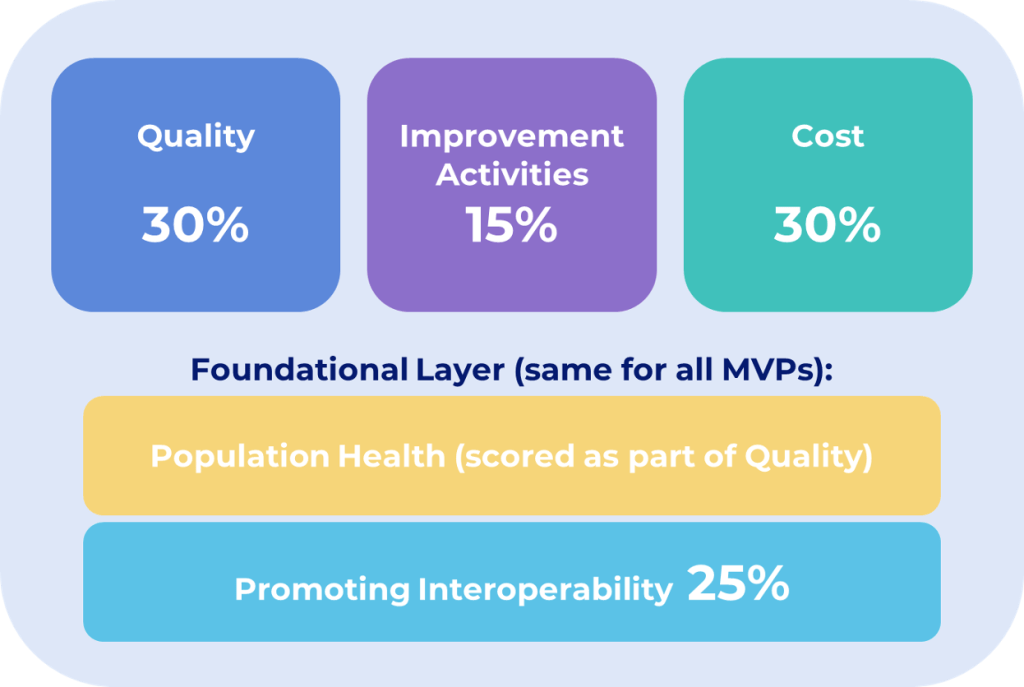
Each MVP has its own specific set of quality measures, improvement activities (IAs), and cost measures, and you are limited to those measures and activities when reporting the MVP. The Promoting Interoperability (PI) category is included as part of a “foundational layer,” meaning that PI requirements are the same for every MVP. Also included in the foundational layer is a population health measure, which contributes to your overall Quality score.
Can I Report an MVP Through a Registery?
Since 2023, Qualified Registries (QRs) and Qualified Clinical Data Registries (QCDRs), such as the American College of Rheumatology’s RISE QCDR, have been required to support all measures in the Quality, IA, and PI categories of the MVPs relevant to their clinicians. They are not required to support the Cost category, Population Health measures, QCDR measures, or the CAHPS for MIPS Survey.
How Are MVPs Different from Traditional MIPS?
The table below highlights the differences by category between reporting traditional MIPS versus reporting an MVP.
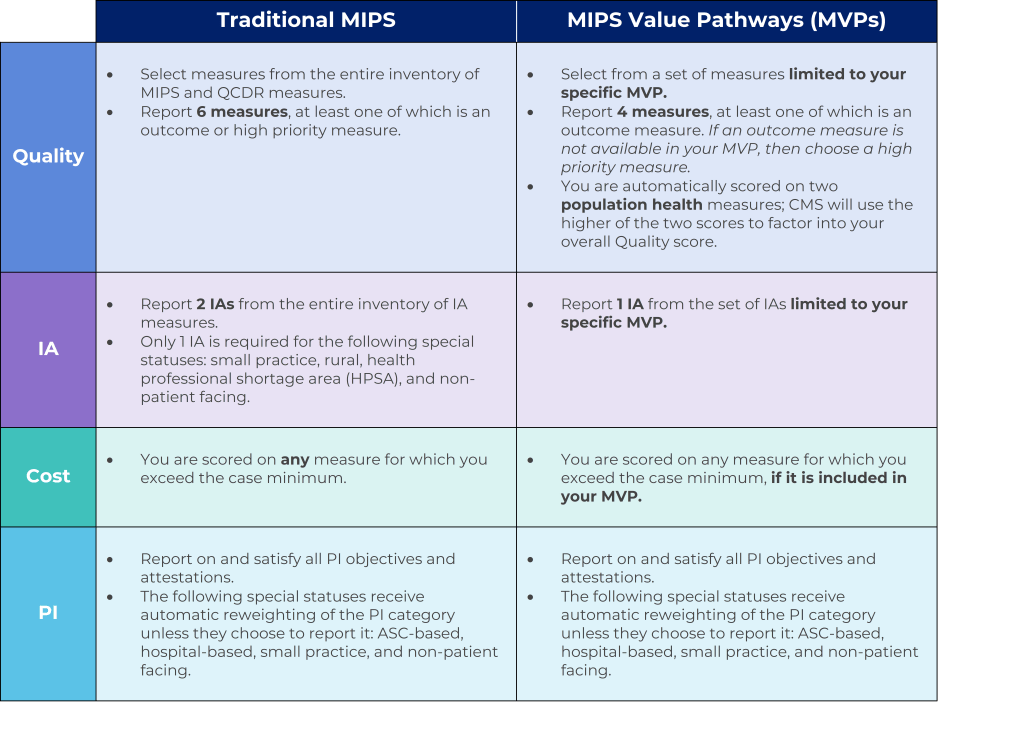
If you choose to report both traditional MIPS and an MVP, CMS will assign you the higher of the two scores.
How Do I Report an MVP?
To report an MVP for the 2025 performance year, you must register between April 1, 2025, and December 1, 2025, at 8 pm ET. Registration is available through your QPP account.
At the time of registration, you must include the following information:
- The MVP you are choosing to report,
- Any administrative claims measures you would like to be included as 1 of your 4 required Quality measures,
- Whether you are planning to count the CAHPS for MIPS Survey measure towards 1 of the 4 required Quality measures, and
- Your participation level (group, subgroup, individual, APM).*
**If you report at the group level and are part of a multispecialty group, you will be required to report at the subgroup level starting in 2026.*
If you are an Anatomy IT client, we will discuss whether to report an MVP during your kickoff call.
What Measures Are Included in the MVP for Rheumatology?
Click on the category names below to see the measures and activities included in the Advancing Rheumatology Patient Care MVP.
Otolaryngological Care Measures (Specific to This MVP)
Advancing Rheumatology Patient Care MVP Quality Measures
- 39: Screening for Osteoporosis for Women Aged 65-85 Years of Age (added in 2025)
- 130: Documentation of Current Medications in the Medical Record (high priority)
- 134: Preventive Care and Screening: Screening for Depression and Follow-Up Plan
- 176: Tuberculosis Screening Prior to First Course of Biologic and/or Immune Response Modifier Therapy
- 177: Rheumatoid Arthritis (RA): Periodic Assessment of Disease Activity
- 178: Rheumatoid Arthritis (RA): Functional Status Assessment
- 180: Rheumatoid Arthritis (RA): Glucocorticoid Management
- 487: Screening for Social Drivers of Health (high priority)
- 493: Adult Immunization Status
- 503: Gains in Patient Activation Measure (PAM®) Scores at 12 Months (outcome)
- ACR12: Disease Activity Measurement for Patients with PsA
- ACR14: Gout: Serum Urate Target (outcome)
- ACR15: Safe Hydroxychloroquine Dosing (high priority)
- UREQA2: Ankylosing Spondylitis: Appropriate Pharmacologic Therapy (high priority, added in 2025)
- UREQA9: Screening for Osteoporosis for Men Aged 70 Years and Older (added in 2025)
- UREQA10: Ankylosing Spondylitis: Controlled Disease Or Improved Disease Function (outcome)
- AHE_3: Promote use of Patient-Reported Outcome Tools
- BE_1: Use of certified EHR to capture patient reported outcomes
- BE_4: Engagement of patients through implementation of improvements in patient portal
- BE_6: Regularly Assess Patient Experience of Care and Follow Up on Findings
- BE_15: Engagement of patients, family and caregivers in developing a plan of care
- BE_24: Financial Navigation Program
- BE_25: Drug Cost Transparency
- BMH_2: Tobacco use
- EPA_2: Use of telehealth services that expand practice access
- PM_16: Implementation of medication management practice improvements
- PM_26: Vaccine Achievement for Practice Staff: COVID-19, Influenza, and Hepatitis B (added in 2025)
- PSPA_28: Completion of an Accredited Safety or Quality Improvement Program
- PCMH: Electronic submission of Patient Centered Medical Home accreditation
- MVP: Practice-Wide Quality Improvement in MIPS Value Pathways
*Note:** EPA_1 (Provide 24/7 Access to MIPS Eligible Clinicians or Groups Who Have Real-Time Access to Patient’s Medical Record) was removed in 2025 and is no longer available for reporting in either traditional MIPS or this MVP*
- Rheumatoid Arthritis **(added in 2025)
20-episode case minimum
- Total Per Capita Cost (TPCC)
20-episode case minimum
Foundational Layer (Applies to All MVPs)
- 479: Hospital-Wide, 30-Day, All-Cause Unplanned Readmission (HWR) Rate for the Merit-Based Incentive Payment Systems (MIPS) Groups
- 484: Clinician and Clinician Group Risk-standardized Hospital Admission Rates for Patients with Multiple Chronic Conditions
All of the following attestations and measures are required (no exclusions):
- Use of CEHRT
- Actions to Limit or Restrict Interoperability of CEHRT
- ASTP/ONC Direct Review
- High Priority SAFER Guides Assessment
- Security Risk Analysis
- Provide Patients Electronic Access to Their Health Information
All of the following measures are required (unless claiming an exclusion):
- e-Prescribing
- Query of Prescription Drug Monitoring Program (PDMP)
- Immunization Registry Reporting
- Electronic Case Reporting
One of the following options is required:
- Option 1: Support Electronic Referral Loops by Sending Health Information + Support Electronic Referral Loops by Receiving and Reconciling Health Information
Exclusions are available for both measures in this option.
You can optionally report on one (only one) of the following measures for 5 bonus points in the PI category:
- Syndromic Surveillance Reporting
- Clinical Data Registry Reporting
- Public Health Registry Reporting
Is Reporting the MVP for Rheumatology in 2025 Worth It?
Yes. CMS is considering making MVP reporting mandatory starting in 2029. That means there are only a few MIPS performance years left to find flaws, gather data, and recommend improvements before MVPs become the only way in which you can participate in MIPS and avoid a penalty. By reporting the Advancing Rheumatology Patient Care MVP, you will:
- Gain invaluable experience to prepare you for mandatory MVP reporting,
- Not negatively impact your MIPS payment adjustment as long as you also report traditional MIPS (even if you score poorly in the MVP), and
- Be able to provide real-world feedback to CMS to help them improve the MVP available to you before MVP reporting becomes mandatory. You can communicate with us to describe your experience with the MVP or you can tell CMS directly by commenting on the 2026 Medicare Physician Fee Schedule Proposed Rule this summer or by following the steps outlined here by CMS.
Next Steps
- Share this information with your colleagues.
- Subscribe to our blog to get alerts on this and other important issues. You can subscribe using the field in our website footer below.
- If you are an Anatomy IT client, contact your MIPS Expert if you have any questions.
- If you are not an Anatomy IT client, contact us to learn more about our MIPS Success Plan and to reap the rewards of our combined decades of experience.
**

Written By: **Jessica Peterson, MD, MPH
About the Author: Jessica Peterson, MD, MPH is the Senior Director of Value-Based Care Policy at Anatomy IT.