The Centers for Medicare and Medicaid Services (CMS) has officially released the 2025 Quality Payment Program (QPP) final rule. The 3,088-page final rule contained many changes that will take place in the 2025 MIPS performance year and beyond.
This blog post breaks down the finalized changes to the QPP and MIPS for 2025. Check out our 2025 Top Final Changes Report for an overview of changes by MIPS category and a list of Quality measure changes.
Performance Threshold
CMS finalized maintaining the current threshold to avoid a penalty at 75 points in 2025.
Category Weights
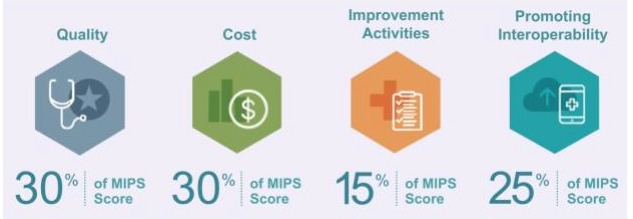
There will be no changes to performance category weights in 2025.
Quality Category
Measure Scoring
CMS is changing the way it scores some topped out measures to instead use flat benchmarking to assign performance points (see Table below). This will only apply to measures that belong to specialty sets with limited measure choice and a high proportion of topped out measures.
Beginning with the 2025 performance period, CMS will publish a list each year in the Federal Register of topped out measures that they determine to be impacted by limited measure choice.
Unlike the proposal, the 9th decile will be included in the scoring range, corresponding to scores with a performance rate of 99 percent.
The following measure scoring rules will remain in effect:
- For large practices (>15 clinicians), measures will be scored on a 1-10 point scale instead of a 3-10 point scale.
- For small practices, the 3-point floor will remain.
Bonuses*
- No change to the small practice bonus or the improvement score bonus.
Measures*
CMS finalized the following changes to the Quality measure inventory:
- 7 new measures
- 10 measure removals
- 66 existing measures with proposed substantive changes
In the coming weeks, we will publish our analysis of these proposed quality measures changes for the specialties we serve.
Data Completeness Threshold
- CMS will maintain the data completeness threshold at 75% in performance years 2025 – 2028 (previously, this threshold was only finalized through performance year 2026).
Cost Category
Scoring
CMS has finalized a substantial change to the way in which they score cost measures beginning with the 2024 performance period.
- Previously, CMS assigned cost measure points based on the percentile in which a clinician’s or group’s performance falls. For example, someone in the 99th percentile (the highest costs) would get 1-1.9 points.
- Finalized Change: CMS will set the median cost for a measure as 7.5 points. The remaining deciles will be determined by using standard deviations from the median.
- This will decrease the likelihood of inappropriately low scores for measures that have little variation in total costs.
Measures
CMS has finalized, as proposed, modifications to two existing episode-based cost measures:
- Cataract Removal with IOL Implantation
Currently named Routine Cataract with IOL Implantation
- Reduced exclusions: The revised measure includes patients with certain previously excluded ocular conditions, such as glaucoma and macular degeneration, in the measure cohort.
The list of excluded conditions includes 563 codes (this is a 62% reduction in the available exclusions as the current list includes 1,475 codes)
- Currently named ST-Elevation Myocardial Infarction [STEMI] Percutaneous Coronary Intervention [PCI])
- Expanded patient cohort: Would include STEMI, non-STEMI, and those with PCI without either STEMI or non-STEMI diagnoses.
- Additional Sub-Groups: Would add sub-groups for STEMI, non-STEMI, and other inpatient PCI episodes.
- Added exclusion and risk adjuster: The proposed revised measure excludes episodes with cardiac arrest and risk adjusts for patients with a history of tobacco use.
CMS has finalized the addition of six new episode-based cost measures:
- Respiratory Infection Hospitalization (acute inpatient measure)
- Chronic Kidney Disease (chronic condition measure)
- End-Stage Renal Disease (chronic condition measure)
- Kidney Transplant Management (chronic condition measure)
- Prostate Cancer (chronic condition measure)
- Rheumatoid Arthritis (chronic condition measure)
In a huge win due to Anatomy IT’s identification of the post-field-testing addition of ophthalmic drops to the list of Part D medications and our subsequent coalition building and advocacy, CMS has modified this measure to remove all ophthalmic medications from the measure specification so that ophthalmologists do not get inappropriately attributed this measure.
Improvement Activities
CMS has finalized significant changes to the reporting requirements for this category. There are also significant changes to the list of available Improvement Activities.
Removal of Activity Weights
Previously, improvement activities (IAs) were either medium-weighted or high-weighted. These weights corresponded to how many points the IA contributed to the IA category (10 or 20, respectively). CMS has eliminated IA weights and, instead, is allowing all IAs to contribute equally.
Reporting Requirements Linked to the Number of IAs Submitted, Not Points
- For all MVP Participants
Attest to 1 IA
- MIPS Participants with the small practice, rural, non-patient facing, or health professional shortage area special status
- Attest to 1 IA
- Attest to 2 IAs
Improvement Activities List
There are several changes to the list of improvement activities (IAs), including:
- Two new IAs, neither of which are relevant to our specialists.
- One change to an existing IA
IA_ERP_6: COVID-19 Vaccine Achievement for Practice Staff
Now IA_PM_26: Vaccine Achievement for Practice Staff: COVID-19, Influenza, and Hepatitis B
- IA_EPA_1: 24/7 Patient Access
- IA_PM_12: Population Empanelment
Delayed to 2026
- Delayed to 2026
- Delayed to 2026
- Delayed to 2026
Promoting Interoperability (PI)
In a huge win for our long-term advocacy efforts, CMS has finalized a policy to no longer assign a PI score of zero points for clinicians and groups that have multiple PI submissions. Instead, CMS will calculate a score for each data submission received and assign the highest of the scores. This change will begin this year (performance period 2024)!
MIPS Value Pathways (MVPs)
CMS has finalized 6 new MVPs covering ophthalmology, dermatology, gastroenterology, pulmonology, urology, and surgical care.
For both the ophthalmology and dermatology MVPs, the only proposal that was not finalized was the modification of IA_BE_4: Engagement of patients through implementation of improvements in patient portal. All other aspects of these MVPs were finalized.
CMS has also finalized limited modifications to current MVPs and has consolidated two neurology MVPs (Optimal Care for Patients with Episodic Neurological Conditions and Supportive Care for Neurodegenerative Conditions) into a single MVP (Quality Care for Patients with Neurological Conditions).
In the coming weeks, we will publish analyses of MVPs relevant to our clients. In the meantime, MVPs remain voluntary.
Next Steps
- Share this information with your colleagues.
- Check out our Top 2025 Final MIPS Changes Report.
- In the coming weeks, we will post an analysis of the Quality measure changes and an analysis of the MVPs.
- On December 10, 2024, we will host a webinar with Q&A on the 2025 QPP Finalized Changes.
- Subscribe to our blog to get alerts on this and other important issues. You can subscribe using the field in our website footer below.
- If you are an Anatomy IT client, contact your MIPS Expert if you have any questions.
- If you are not an Anatomy IT client, contact us to learn more about our MIPS Success Plan and to reap the rewards of our combined decades of experience.
**

Written By: **Sarrah Hakim, MHSA
About the Author: Sarrah is a Manager of Health Policy at Anatomy IT.